

Le Tastevin Wine Tasting – May 13, 2026 - Deiss Alsace and German Whites/Reds
Starter (Old Club Wines)
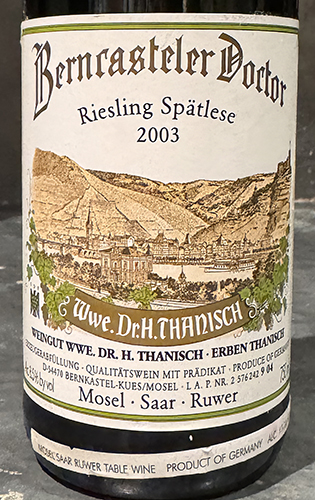
2003 Berncasteler Doctor, Dr. H Thanisch, Erben Thanisch – Spätlese
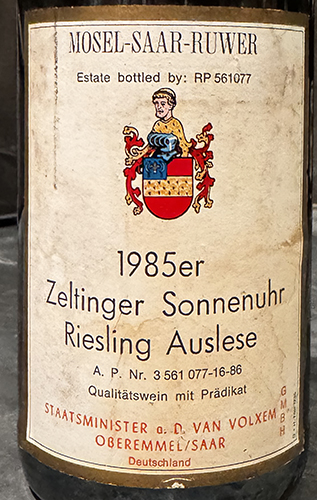
1985 Zeltinger Sonnenuhr, Van Volxem – Auslese
Alsatian White (Domaine Marcel Deiss)
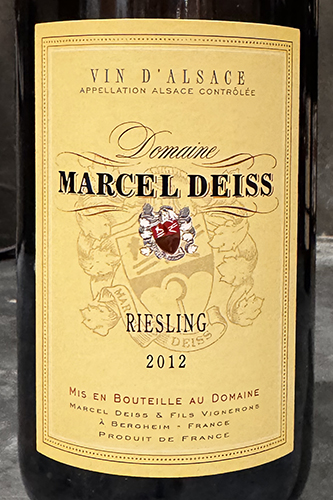
2012 Marcel Deiss Riesling
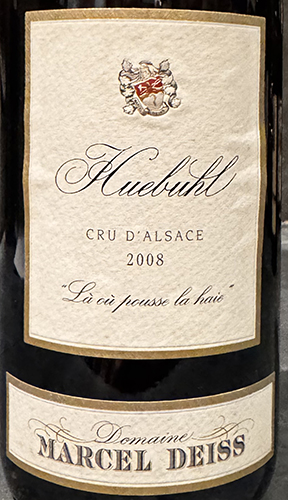
2008 Huebuhl (blend)
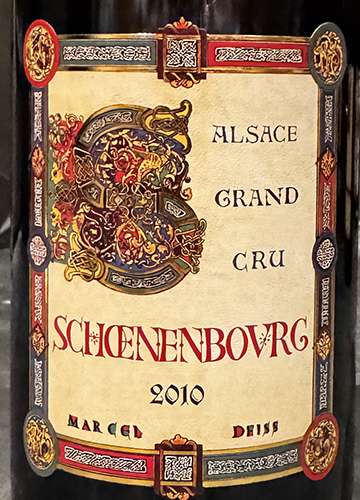
2010 Schoenenbourg (Riesling, plus Pinot Gris, Gewurztraminer, others)
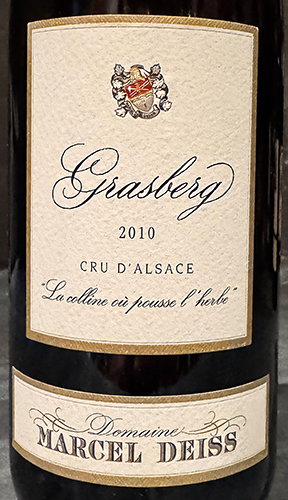
2010 Grasberg (Riesling, Pinot Gris, and Gewurztraminer)
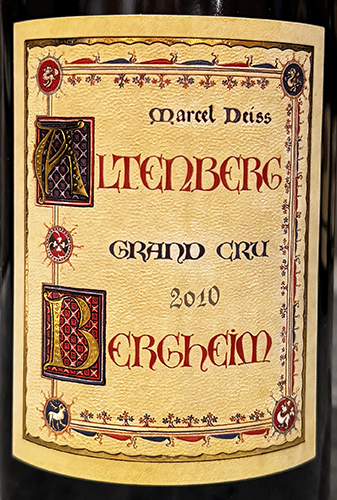
2010 Altenberg de Bergheim GC Riesling (blend; RP 96, Vinous 95+, JS 93)
2012 Marcel Deiss Gewurztraminer
Reds (Pinot Noir)
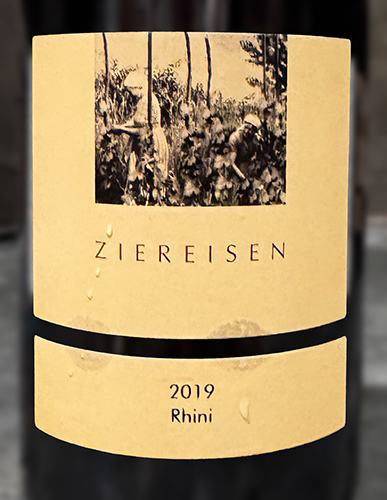
2019 Rhini Zierreisen, Spätburgunder (Baden)
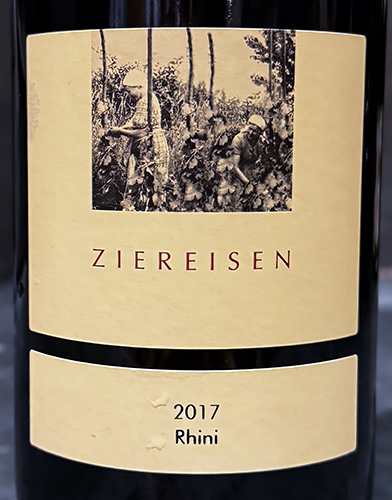
2017 Rhini Zierreisen, Spätburgunder (Baden)
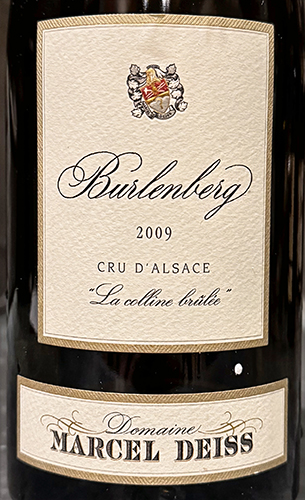
2009 Domaine Marcel Deiss Burlenberg, Cru d‘Alsace (Alsace) (Pinot Noir, Pinot Gris)
Dessert (Extremely Old Club Wines – Ganz Alte Kaker)
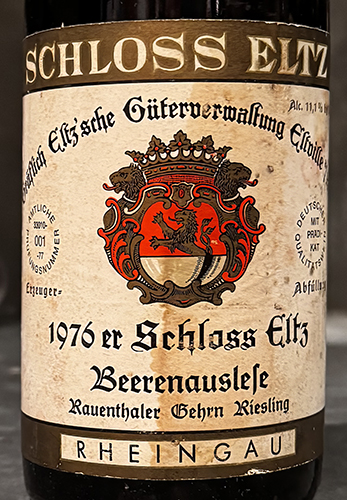
1976 Gräflich Eltz’sche Güterverwaltung Eltville (Rheingau), Riesling Beerenauslese
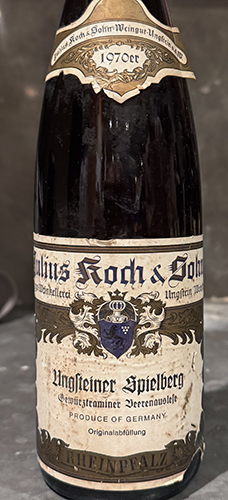
1970 Weingut Julius Koch & Söhne, Ungsteiner Spielberg (Pfalz), Gewürztraminer Beerenauslese
Images of Sampled Wines:
Alsace
A mixture of French and German characteristics pervades this northeastern fragment of France, cut off from the rest of the country by the barrier of the Vosges (Vozgh) mountains, and separated from Germany by the Rhine. The colorful combination of cultures is the result of history, shifting borders and influx of different cultures.
Several things are evident in the location of the Alsatian wine region. First, it is long and narrow, on the eastward-facing slopes of the Vosges mountains, following the Rhine river for a 110 km north-south stretch from Mulhouse north to Strasbourg (Figure left). Second, although not a high range, it effectively creates a leeward effect. Moisture carried off the Atlantic precipitates on the western slopes, leaving the eastern slopes with essentially a continental climate, with hot summers, cold winters, and large diurnal swings. Alsace is one of the driest wine regions in France (annual rainfall is 500-600 mm or 20 in.), drier than many southern regions normally considered arid, including Languedoc and southern Rhone.
The geology of the Vosges Mountains is quite complex (Figure above), with an array of strata unified by age. Very old soils are derived from four or five types - granites with or without mica, sandstone, slate, schist, and various volcanic derivatives. Mixed in are various sedimentary soils, with limestones, marls, and accompanying clays. In some areas, older soils have eroded marl and clay, leaving pure rock. Geologic uplifting created the Rhineland mountain range that, around 50 million years ago, collapsed, creating the Rhine Plain. Successive collapses contributed to a further shifting of rock layers. Glacial events further added deposits of loess and gravel. Although the Vosges wine region is an eastward-facing region, the best sites are found on small plots that have a southward to southeast-facing aspects.
The vineyards of Alsace are dotted with medieval towns of cobbled streets and timbered buildings, reflecting - as do the wines - the region's myriad Gallic and Germanic influences. The grapes are a mixture of German, French, and the exotic, with the German Riesling and Gewurztraminer (written without an umlaut in Alsace), the French Pinot Gris, and the decidedly exotic Muscat comprising the four principal varieties. Sylvaner, another Germanic grape (a cross between Traminer and a now largely unknown Österreichisch Weiss) features to some extent, while other French varieties include Pinot Noir, Pinot Blanc, Auxerrois, and Chasselas. While Gewurztraminer is definitely German (and fine examples are still found in the Pfalz, to the north), only in Alsace is it quite so spicy. And only in Alsace do you find spicy Pinot Gris, a grape that is somewhat neutral elsewhere. Even the Pinot Blanc may produce spicy wines in Alsace, although this is normally due to the inclusion of the fat-spicy Auxerrois grape.
Little red wine is made in Alsace, mostly intended principally for local restaurants and Weinstuben, although Pinot Noir is being increasingly planted and now outstanding efforts are being made. Ninety percent of the wine in Alsace is white. Traditionally, these fruity wines were dry, although some varieties, such as the Gewurztraminer, have always been made less dry than others. With the introduction of Vendange Tardive (VT, akin to Auslese) and Selection de Grains Nobles (SGN, akin to Beerenauslese) wines, growers have deliberately reduced yields to chase high sugar levels. Wanting to introduce Francophile terms, Hugel & Fils, who had used German descriptions, pioneered the decree authorizing and controlling the commercial designations of Vendange Tardive (VT) and Selection de Grains Nobles (SGN). The decree was passed in March 1984, and these styles have been universally produced since the botrytis-rich vintage of 1989. Although there has been an explosion in the numbers of producers making and selling VT and SGN wines-from just two or three prior to the decree to now literally hundreds, the production of these late-harvest wines remains minute at just 2 percent of total Alsatian wine output. The vast bulk of Alsace wines have traditionally been dry, but these so-called dry wines have become increasingly sweet over the last 10 years or so, and some are very sweet indeed. So much so that it has become almost impossible for the wine-drinking public to tell whether the wine they are buying is dry or sweet. This is not because Alsace producers deliberately chose to sweeten their wines; it is merely the byproduct of good intentions. All the best producers, including many of the names commonly encountered on export shelves, have dramatically cut their yields, particularly in the grand cru vineyards. Reduced yields produce higher must weights, and in sun-blessed Alsace this soon leads to a choice between higher alcoholic wines or significant amounts of residual sugar. However, the grands crus and other prized sites are not so much sun-blessed as sun-traps: lowering yields in these vineyards has increased must weights to the point where, even at 15 percent alcohol, the wines have so much residual sugar that they are really quite sweet.
Alsatian Vintage Rating - Wine Spectator
2012 - 90 - Drink or hold (A reduced crop of pure and elegant whites with good ripeness. Pinot Gris excelled; favored top producers for Riesling and Gewurztraminer)
2010 - 93 - Drink or hold (A small crop, but top wines offer fine concentration and balance firm structure with finesse)
2009 - 94 - Drink or hold (Lithe, lively dry wines, offering fine concentration and balance; VTs and SGNs show great purity)
2008 - 94 - Drink or hold (Racy dry whites that pair intense acidity and backbone with pure fruit flavors; very little botrytis)
Domaine Marcel Deiss
Jean-Michel Deiss has been called a lot of things: Maverick, renegade, terrorist, genius, crackpot and fouteur de merde (shit stirrer). But one thing that all his title-throwing friends can agree on is his wines are special, unique and altogether delicious. Along with his wife Clarisse and their talented winemaker Marie-Hélène Cristofaro, Jean-Michel has transformed the Domaine from an Alsatian also-ran to one of the most respected wineries on earth. In an area already known for producing great wines that speak of the soil, Jean-Michel has through innovation, bravery and a little craziness taken his wines to new heights.
The Deiss family is a long line of winegrowers, blacksmiths and bellfounders who settled in Alsace after the Thirty Years War in 1744 and the province’s attachment to France. The Domaine itself was created in 1947 by Jean-Michel’s father Marcel Deiss after he returned from WWII. Located in Bergheim next to Ribeauvillé, in the heart of the Grand Cru area, it is currently managed by Mathieu Deiss with the help of his father Jean-Michel. The estate has fought for a more qualitative production, based on the terroir rather than on cloned grape varieties, the inclination towards biodynamics, very low yields, and agroforestry. Today they produce a scant 10,000 cases from traditional Alsatian varieties, and these can be divided into three separate styles:
Les Vins de Fruits (Fruit Wines) - wines comprised of only one varietal like many other wines in Alsace. They are made from Riesling, Pinot Gris, Pinot Blanc, Gewürztraminer and Muscat grapes. The name of the vineyard is also listed on the label, kind of the traditional Alsatian wine.
Les Vins de Temps (Time Wines) - These are wines where the emphasis is placed upon the vintage and include wines of both Vendages Tardives and Selection de Grains Nobles character.
Les Vins de Terroir (Terroir Wines) - These are wines that are sold by the name of vineyard only to express the style and personality of that particular soil type and micro-climate.
Soil is the ultimate playground for Jean-Michel. His Domaine covers 67 acres of some of the greatest Alsatian sites: Englegarten, Rotenberg, Grasberg, Altenberg. The list of premier vineyards and Grand Crus goes on and on. Deiss counts some 220 different sites among his 27 ha of vines. The Englegarten was once a riverbed and now has a thin layer of gravel on the surface. The Rotenberg is heavy with iron and limestone. The Grasberg vineyard is rocky and porous with lots of fossilized crustaceans. And the Grand Cru of Altenberg is the most diverse of them all, with four separate faults located within the vineyard creating a dizzying diversity of soils within this one site alone.
Alsace has always been known as an area of diverse and unique soil types, a fact that requires much balance between grape variety and soil type. Unlike elsewhere in France and even most parts of Europe, traditionally the wines of Alsace have consisted of a single grape variety. Over the years certain grape varieties have become synonymous with certain vineyard sites. This expression of the grape and the specific soil that it hails from has become the backbone for great Alsatian wine.
The name Deiss lingers on the tips of tongues turned towards Alsace, and not always in the positive. Many of his contemporaries and peers think he has gone over the line. Jean-Michel believes that it is the soil that should be praised and not a specific grape variety within it. So much so that Jean-Michel does the unthinkable for Alsace: He blends several different grape varieties together to create a wine that is from each individual vineyard, not an individual grape. While blends of grapes were once common (called Edelzweicker) blending grapes from within a single vineyard, particularly a Grand Cru site, was considered blasphemy. To top it off, Deiss often uses the noble Riesling in his blends. Well, this was considered by many to be just plain stupid. So stupid in fact that until 2005 it was illegal. Deiss operated outside of the law by not labeling his Grand Cru wines with the grape varietal on the label. Many in Alsace believe that blending is used to fix faults within the wine and not to add character or complexity. The word polluting is even thrown around. But to understand his wines one must understand the man himself. One must understand that to Jean-Michel it is the soil that is of the utmost importance, and that he is not afraid of taking risks when it comes to producing the best wine that he can.
Deiss’ finest wines are bottled simply by the name of Marcel Deiss along with the names of their vineyard sources: such as the grand crus Schoenenbourg and Altenberg de Bergheim vineyards, and premier crus such as Burg, Rotenberg, Gruenspiel and Engelgarten. But no mention of any grape on the label.
Deiss himself says that a turning point was in 1993, when a Riesling from his Burg vineyard was criticized for not tasting like a “Riesling.” This prompted Deiss to not just remove the names of grapes from his single vineyard bottlings, but also to start planting as many as seven different varieties in his best vineyards (which, also unusually, Deiss harvests and co-ferments all at once). No more blind following of tradition, he has said, because of obligatory feelings. “I realized that the grape in a vineyard is an ingredient, but not a dish… it is wrong to transform the energy of a unique place into a ‘Riesling’… by having many varieties in Burg I am giving the terroir different letters so it can create sentences.”
Hence, no winemaker in Alsace focuses as much on terroir as Jean-Michel Deiss. As in our organic wine of the day: the 2003 Marcel Deiss Engelgarten, which is a field blend composed mostly of Riesling, Pinot Gris and Auxerrois. True to Deiss’ intentions, this white wine does not taste of any one grape; but rather, in the words of Deiss’ winemaker Marie-Hélène Christofaro, like a “filtering” of wine through the gravel dominating Engelgarten’s soil. Nevertheless, the nose is honeyed, suggesting ripe, juicy, white fleshed stone fruits (peach, nectarine and lychee); and a steely, austere entry gives way quickly to almost sweet, viscous sensations of the honeyed fruit, before finishing with a mouth-watering bang and emphatically stony, faintly bitter, citrus peel dryness.
Though Deiss employs some of the same methods other winemakers use, few are as dedicated to the vine and the soil as he is. Many wineries employ organic farming methods such as Deiss does. But how many have been strictly organic for the last 30 years? Or have been strictly biodynamic for the last 10? Or when planting new vines have been known to dynamite the rock bed so that his young vines have a chance to dig their roots way down deep in search of minerals and nutrients? Another method employed is a high vine density within the vineyards to force the vine to compete with others in a race to produce the best fruit they can. Yields are kept ridiculously low. The average amount of wine yielded from a single vine in Alsace runs about four bottles, whereas Deiss’ Grand Cru vines yield less than one bottle per vine. The grapes are harvested by hand, which brings us to one of Jean-Michel’s more controversial philosophies: Deiss not only blends different varieties of grapes together from a single vineyard, he also harvests all of the grapes within that vineyard at the same time. Deiss proclaims that they all ripen at the same time due to his unique soil characteristics, a fact that many claim to be impossible. The grapes are then fermented together as well, another seldom, if ever, used tactic.
Jean-Michel is a passionate and somewhat controversial preacher of the Alsatian tradition of “complantation”, or field blending varieties in the vineyard. He believes that a true expression of a site’s terroir is only possible through blending the traditional Alsatian varieties in proportions suited to a particular site. He recently managed to convince the INAO (the French organization charged with regulating French agricultural products with Protected Designations of Origin) to change regulations allowing a blend to have Grand Cru status for the first time.
The Bergheim valley is unique in Alsace: a hill blocks the cold air flowing down from the Vosges which makes this valley warmer than the other Grand Cru valleys in the area. Jean-Michel is also fervent follower of biodynamic practices. He uses very dense planting to reduce vine vigour, producing tiny, highly concentrated berries. The terroirs are a patchwork quilt created by the various North-South and East-West faults. As such, Jean-Michel treats each parcel of vines separately, believing that the nurturing of vines. In the winery the grapes are given the utmost care. Deiss employs several pressing machines so that the grapes undergo the most gentle of pressings before reaching the barrels and tanks. Some wines are designed for immediate consumption and are fermented in stainless steel to preserve the fresh fruit flavors, while others due to low levels of nitrogen found within the grape go through incredibly long and slow fermentations in large foudres. Only indigenous yeasts found on the grapes themselves are used in the fermentation process. Deiss also employs extended sur lie aging and frequent batonnage to increase the weight and character of his wines which are bottled unfined and unfiltered.
“Just about any French vineyard owner will talk terroir given the opportunity, but no one argues the case for terroir more passionately than Marcel Deiss.” Robert Parker
“Jean-Michel Deiss has been growing some of the finest wines in Alsace for more than a quarter century and with them – as well as with his passionately articulate discourse – capturing the imagination and affection of wine enthusiasts world-wide. But the bearded sage of Bergheim is never satisfied, and beginning in the late eighties, he began to completely re-think his wines and means of truly embracing his terroirs. The result was new acquisitions and plantings to achieve (beginning a decade ago) single-vineyard, field-blend bottling the likes of which had scarcely been seen in Alsace for the better part of a century, and to certain of which the governing authorities have recently been persuaded (perhaps as much by Deiss’ metaphysics of terroir as by the profundity of his vinous results) to grant the status “Grand Cru.” Wine Advocate, February 2008
2012 Riesling - Vinous 89 points “Bright straw with a gold tinge. Peach, tea and spice on the forward nose. Rich, ripe and suave, with lovely tropical fruit flavors that persist nicely at the back, with a touch of alcoholic heat becoming apparent with aeration. The grapes for this wine are sourced from three main areas: Saint Hippolyte (on soils rich in granite and clay that yield wines with less acidity), Bergheim (slightly bigger, richer wines), and a few small plots between Riquewihr and Béblenheim. Mathieu Deiss told me that “when I first came to work at the estate, I thought why not join these grapes together rather than make single bottlings of each? It’s not as if we don’t have enough single-site wines, and besides, I didn’t think our clients were die-hard fans of the Saint Hippolyte or Bergheim wines themselves.”
2010 Grasberg - The Hill Where The Grass Grows (RP 93, drink until 2025) - Exotic, fat and luminous semi-dry wine. Nose: explosion of jammy citrus fruits and fresh mint leaves. Palate: acid energy of large citrus fruits. Length, smoother finish but with an unusual vitality. This site, at an altitude of 280 m is located at the top of the hillock which bears the Grand Cru Altenberg on its south-facing slope. The thinness of the soil leads the vine to plunge deep into the subsoil in search of energy giving a very complex and long wine, marked by the poor limestones of the Grande Oolithe where the vine must deeply search for the ultimate Energy of its reproduction. The Grasberg is entirely tense, tight and complex and bears witness to this initiatory quest. Blen of Riesling, Pinot Gris, and Traminer. Livestock farming, aged in oak barrels on the lees for 12 months. 12.5%, organic.
2008 Huebuhl - At the top of the small pass separating Bergheim from Ribeauvillé, the Huebuhl (literally, the early and humid place), a slight depression gently sloping towards the south, joining the Gruenspiel to the west and the Rotenberg to the east, produces expressive wines: an envelope of almonds, zest, fat and toasted, a deep acid structure marked by cold lacustrine clays and luminous and windy autumns that channel and contain the Noble Rot. A great sweet wine, but full of restraint, sharp and graphite coldness. The purity of the mouth, in exact correspondence with the nose, is extraordinary and testifies for this vintage without botrytis, where however the Huebuhl has made a wine at the level of the 2005 or 2010.
2010 Schoenenbourg - (WA 94, ST 94, WS 92) Schoenenbourg is not just any Grand Cru, it is the vineyard that changed everything for Jean-Michel Deiss. Bequeathed to him on its former owner's deathbed, this steep south-facing plot in Riquewihr sits on extraordinary Keuper marl and gypsum-rich soils, widely considered the longest-ageing wine in all of Alsace, capable of evolving for decades. “Fresh peach and citrus lusciously inform the Deiss 2010 Schoenenbourg, whose creamy texture and honeyed richness, are matched by vivacious juiciness. Sweetness here is supportive without remotely getting the upper hand, so that I can well imagine over the 20-25 years during which this beauty will deserve to be admired, its versatility at table will vary inversely with a diminishing sense of sweetness.” WA
2010 Domaine Marcel Deiss : Altenberg de Bergheim Grand cru 2010 - Altenberg de Bergheim was the vineyard that set Jean-Michel Deiss down the path of his famous field blends. When he took over the domaine in the 1980s, Jean-Michel vinified Altenberg the way he had received it, as separate cuvées of Riesling, Pinot Gris, and Gewurztraminer. In the 1990s, Michel Bettane, France’s most influential wine reviewer, visited Jean-Michel regularly. The pair were fascinated with Altenberg’s dominance: the terroir was so powerful it eclipsed the grape varieties. So, in the cellar one day, they made an Altenberg blend; it was vastly superior to its components. That moment was Jean-Michel’s Eureka: “The production of this wine was a milestone in my life as a wine-grower and marked a break with the variety-over-terroir dominance under which the Alsace region has suffered so greatly for the past 100 years.” Since 2001, after epic efforts on the part of Jean-Michel, the legislation for Altenberg de Bergheim Grand Cru was modified to allow all thirteen Alsatian varieties in its composition instead of being restricted to one only of a shorter list (generally Riesling, Gewurztraminer, and Pinot Gris, sometimes Muscat, and in the case of Zotzenberg only, Sylvaner). Only one other grand cru at the time, Kaefferkopf, was similarly exempt. Altenberg’s geology is complex. Located in the sub-Vosgian hills, in the heart of the Ribeauvillé fault zone, where hard limestone and marls of the middle and lower Jurassic period are juxtaposed against Vosges sandstone. These fossil-rich formations form a ferruginous, rocky, nutrient-poor, clay topsoil, where the vines must dive deep to find nutrients. As to the vineyard’s micro-climate, on one hand, its southern exposure and isolated position facing the plain leave it almost overexposed, making it a solar, hot terroir, where botrytis is systematic. On the other hand, its soils are cold, and the grapes ripen late. This push and pull of hot and cold contributes greatly to Altenberg’s complexity and paradoxical nature. Altenberg combines the honey and apricots of botrytis with the vibrant citrus of limestone into aromatic fireworks. Jean-Michel: “The Altenberg is not one of the greatest terroirs of Alsace, it is one of the greatest terroirs for white wine in the absolute.” 96+ Robert Parker's Wine Advocate - This wine will be great in 15-20 years, but I wouldn't touch it before. Remarkable finesse and concentration here. Tight tannins.
2012 Gewürztraminer (WE 91) - This richly spicy, full wine has great depth of flavor. It is powerful, concentrated and shows a straight line of purity between the fruit and the final wine. Like many wines from Deiss, this off-dry wine needs to age.
2009 La Colline Brûlée/ Burlenberg 1er Cru (Red)
The burnt hill, a dense and deep wine. It was at the Burlenberg, with its particular geology (a Jurassic limestone slab sculpted by lava flows during the Rhine collapse) that in 1947 Marcel Deiss planted a plot of Pinots, which became the heart of our Grand Vin Rouge project. At Bergheim, 3 km from Ribeauvillé, is well-known for its biodynamic wines. Mathieu Deiss explains that the natural acidity in the wine is due to the elevation of the vineyard. Maturity is pushed to get a lot of tannins out of the grapes but the wine needs time to evolve and to smooth out. The wine is not filtered, and use of sulphur dioxide is kept to a minimum. They work with low yields and plant vines at a high density. They believe that competition, and not green harvest, is the optimal way to reduce yields. According to Mathieu, Alsace on the whole is thinking along the same line. Burlenberg, in a bid to express terroir, is made from a field blend of Pinot Noir and a small proportion of a few other Pinot varieties including Pinot Gris and Pinot Blanc.
2003 Berncasteler Doctor, Dr. H Thanisch, Erben Thanisch – Spätlese
Mosel-Saar-Ruwer. The legendary Berncasteler Doctor vineyard is located behind the village of Bernkastel and is one of the most famous vineyards in Germany. This steep site with a South-South-West orientation consists of medium deep, stony, loamy weathered argillaceous schist. Planted with up to 80 year old vines, full-bodied, spicy wines are grown here. The South-South-West orientation of the vineyard guarantees optimal sunshine throughout most of the day. The Riesling wines from the Berncasteler Doctor are among the most famous and noble white wines in the world.
The “Doctor” wines come from a century-old tale whereby the Elector Boemund of Trier Publicly announced that anybody who delivered a cure to his disease would be richly rewarded. A nobleman handed him a cup of golden wine and he was cured. Thus the wines on the mountains of Bernkastel were bestowed with a doctor’s degree.
The Thanisch family has cultivated wine since the year 1636 and can look back on a history covering almost 400 years. Today the estate is run as a family business in the 11th generation, of which the last four generations were women. The first woman leading the estate was Katharina Thanisch, who was one of the VDP founding members in 1910. Today the estate is managed by Sofia Thanisch. The label is a very Classic Art Nouveau Etiquette from 1901 and depicts the estate, the town of Bernkastel and the Doctor vineyard in the background.
1985 Zeltinger Sonnenuhr, Van Volxem – Auslese
Current vintner Roman Niewodniczanski, from the Bitburger Beer dynasty, set out to find some of the most prized vineyards with some of the oldest vines (some almost 120 years old and even pre-phylloxera) to produce unique Riesling textures that harken way back to older (pre-WW1) drier tastes. Van Volxem are often a highly sought after wines. Bio-dynamically cultured, never chapitilized (added sugar), the must is spontaneously fermented only with indigenous wild yeast that only finish their attenuation the following spring. Eschewing the "lese" pradikat system of classifying these dry wines, Niewodnczanski believes must weight is an insufficient and confusing way to determine quality.
The vineyards are located around Wiltingen in the Saar Valley in a location - where there are steep Devonian slate slopes - that was cultivated for wine even in Roman times. The Jesuits resumed wine cultivation here in the 16th century. Following the French Revolution, the property was secularized and ended up owned by Gustav van Volxem, a wine brewer who had emigrated from Brussels. He saw the potential of location, and subsequently developed one of the most prestigious wine estates in imperial Germany. After four generations in the van Volxem family, Roman Niewodniczanski took over the estate and subsequently restored it to its original state in accordance with preservation standards. He also expanded the vineyard holdings with new premium sites. In 2004, the estate director Dominik Völk joined the team, which is one that is committed to making Van Volxem a leading international estate for white wine. The philosophy of wine-making matches the climate: “cool-climate wines” with moderate alcohol, good structure, complexity, and concentration that reflect the individuality of each location.
Weingut Ziereisen (25.5ha), Efringen-Kirchen / Baden / Germany
Rhini 2019, 2017
Ziereisen is a 25.5 ha vineyard located in the very southern part of Baden in a town called Efringen-Kirchen, directly by the Rhine at the border of Alsace and Switzerland. Basel, Switzerland is the closest city, just 15 kilometers south. Here, Hanspeter and his wife Edel produce outstanding Pinot Noir and Gutedel (Chasselas) as well as a bit of Syrah, Chardonnay, Pinot Gris, and Blanc. “Quality is made in the vineyard. We work with utmost care to create the conditions for high-class wines. In the cellar we only do the minimum of work necessary allowing the wines to rest and time to mature. The French swear by their terroir – in this respect I am a Frenchman.” says Hanspeter Ziereisen.
Perhaps, like Marcel Deiss in Alsace, Ziereisen is creating a fine rebellion across the Rhine. He is part of a group of like-minded producers who wish to wriggle free of the strait jackets of the German wine law, simply making the best wine they can. “What you need to know about me is, everything I do is forbidden. Our philosophy is that wines should reflect their provenance as purely as possible. This is why we treat our vines and wines with great care by minimizing chemical treatments and filtration. In the vineyards, we try to make use of the traditions that our ancestors passed along to us. We produce smooth, elegant, strong, and athletic wines. We aim to achieve a balance between acidity, tannin, alcohol, and aroma. Recipe winemaking is a horror for us. Individuality is the signature of Ziereisen.”
Of course, Burgundy is the homeland of Pinot Noir, as well as Pinot Blanc and Gris and Chardonnay. Efringen-Kirchen’s climatic conditions, coupled with limestone soils, correspond to the conditions of Burgundy. The average temperature (11®C) is similar to that of Burgundy. Chemical fertilizers and sprays are strictly avoided in the vineyard, though this estate is not certified organic. Work in these south-facing vineyards is of paramount importance. After an initial selection in the vineyard, grapes are selected and carefully sorted again in the cellar. The fruit is fermented spontaneously in neutral wood for the top-quality wines and wines and stainless steel for others basic wines. For the red wines, there is a 6-8 week maceration prior to pressing in a pneumatic press. The single vineyard Pinot Noirs from the better sites are transferred to mature in a mix of 30% new and 70% used 225L barriques. The oak comes from the Assmann Büttnerei, a family-run cooperage from the Franken region. In the cellar, Hanspeter follows the philosophy of Hans Gunter Schwartz – “controlled idleness”. Generally, the red wines are on the fine lees for at least 20 months before they are racked and never filtered before bottling.
Hanspeter—originally a trained cabinetmaker, later a winemaker—founded the winery in 1991 and, together with Edeltraud, expanded it to its current size of 21 hectares. Our children, Ida and Johann, now actively support us in the daily operations and at events—and, naturally, we hope that they will one day follow in our footsteps. And since we cannot do everything ourselves, we also rely on a host of helpers who lend us a vigorous hand. Representing them all, we would like to specifically mention our brother-in-law Jörg “Jüggi” Enderlin—our Head of Logistics and the true heart and soul of the business—as well as our Polish and Romanian staff members.
Jaspis Wines – The Treasures Only our very finest wines are bestowed with the name "Jaspis"—named after a gemstone frequently found in our vineyards. And because we set the bar exceptionally high for these wines, they may not be produced in every vintage. Sourced from our finest terroir, from our oldest vines, and matured in our best barrels—with our Jaspis wines, we push our pursuit of quality to the absolute limit. The result is a collection of profound, age-worthy wines, including our "Grauer Burgunder," "Chardonnay," and Gutedel "104," as well as our red "Pinot Noir," "Spätburgunder," and "Syrah."
Premium Wines – The Exceptional All Premium wines originate from a single, specific terroir—the very source responsible for the individual expression of each wine. Spontaneously fermented, they mature for 12 to 22 months on their lees in small and large wooden casks, after which they are bottled without any fining or filtration. A minimum of cellar intervention yields a maximum of character. Here you will find the Gutedel "Steingrüble," the Pinot Blanc "Lügle," the Pinot Gris "Musbrugger," the Chardonnay "Hard," as well as the Pinot Noirs "Tschuppen," "Talrain," "Schulen," and "Rhini," and the Syrah "Gestad."
Rhini, Pinot Noir (Spätburgunder) – Notes of currants, raspberries, and ripe cherries. Muscular and linear. Dense structure of acidity and tannins. Requires time to open up. Aging potential of at least 15 years. Soil and Microclimate: Jurassic limestone with an overlay of iron-rich clay Vine Age: Planted between 1989 and 2000 Clones: Selection Massale, 5286, Wädenswil 245 Vinification: Spontaneous fermentation; approximately six weeks of skin contact; aged on the lees for 20 to 22 months; neither fined nor filtered Wood Usage: Barriques (small oak barrels)—10% new, 90% used oak.
1976 Gräflich Eltz’sche Güterverwaltung Eltville (Rheingau), Beerenauslese (Alc. 11.1%)
This vintage was a remarkable year for German sweet wines. The year was hot and dry, resulting in wines characterized by high concentration, rich fruit and intense sweetness. A 1976 vintage wine from the Gräflich Eltz’sche Güterverwaltung Eltville (often referred to as Schloss Eltz) represents a remarkable example from the Rheingau region. From the post-World War II era through the 1970s, the Gräflich Eltz’sche Güterverwaltung was regarded as one of the premier wineries in the Rheingau, specializing in premium Rieslings. Grapes were frequently sourced from the Eltviller Sonnenberg vineyard site—a location characterized by loess-loam soils. Quality Classifications: From this vintage, noble sweet variants are particularly renowned and highly sought-after; these include: Beerenauslese (BA); Trockenbeerenauslese (TBA); and Auslese. Flavor Profile: Typical of these aged 1976 wines are aromas of ripe peach, honey, and citrus notes, supported by an acidity that—despite the wines' age—often remains remarkably vibrant. Value: These wines are highly sought-after collector's items. A 1976 Schloss Eltz Eltviller Sonnenberg Riesling Beerenauslese can command prices ranging from approximately €299 to over €475 per bottle, while TBA-quality wines can be significantly more expensive.
The 1970 Julius Koch & Sohn Ungsteiner Spielberg Gewürztraminer Beerenauslese is a sweet, specialized dessert wine from the Pfalz region of Germany. Ungsteiner Spielberg is a well-known site in Ungstein, part of Bad Dürkheim. Beerenauslese (BA) is a high-level German quality wine category made from individually selected, botrytized (noble rot) berries. It is characterized by high sweetness, intense flavor, and lower acidity compared to Riesling.
There is little information on the web about this winery, but their contact information still appears to be active (Weinstraße 31, 67098 Ungstein). Just north of the famous spa Bad Dürkheim, situated between Mannheim and Kaiserslautern), the vineyards are part of the Palatinate Forest, together with the Vosges south of the French border, from which it has no morphological separation, form part of a single central upland region of about 8,000 km2 in area that runs sw-ne and forms the western boundary of the Upper Rhine Plain. The vineyard is known for its warm microclimate and limestone-studded, clay soil on a steep south-western, lime- and sandstone hillside just west of Ungstein, now named Dürkheimer Spielberg, which is one of two (the other is Ungsteiner Herrenberg) of the most prestigious, high-quality vineyard sites around Bad Dürkheim. This Beerenauslese Gewürztraminer was designed for high sugar and acidity to assure aging for decades. If well-preserved, it may offer complex tertiary notes of honey, dried apricot, and marmalade, but there is a significant risk of degradation.
Page last updated: May 24, 2026 (EB)
Members: Please contact the webmaster for updates and changes to information contained in this web site.